Artifacts
Attention: This page is only for INTL1830 course work! For more information about my research, please follow my RsearchGate(link on Homepage).
Contrastive Learning for Chest X-ray Classification: A Fusion of Topological Data Analysis and ResNet H.R., Z.L.(Co-first author), F.J., X.Z., H.H., Y.Y., Z.D.
Contrastive learning has shown good scalability, and Topological Data Analysis (TDA) has demonstrated excellent feature extraction performance. In contrast, the performance of traditional CNN networks still needs improvement. This paper was accepted by IEEE DSC in July 2024. 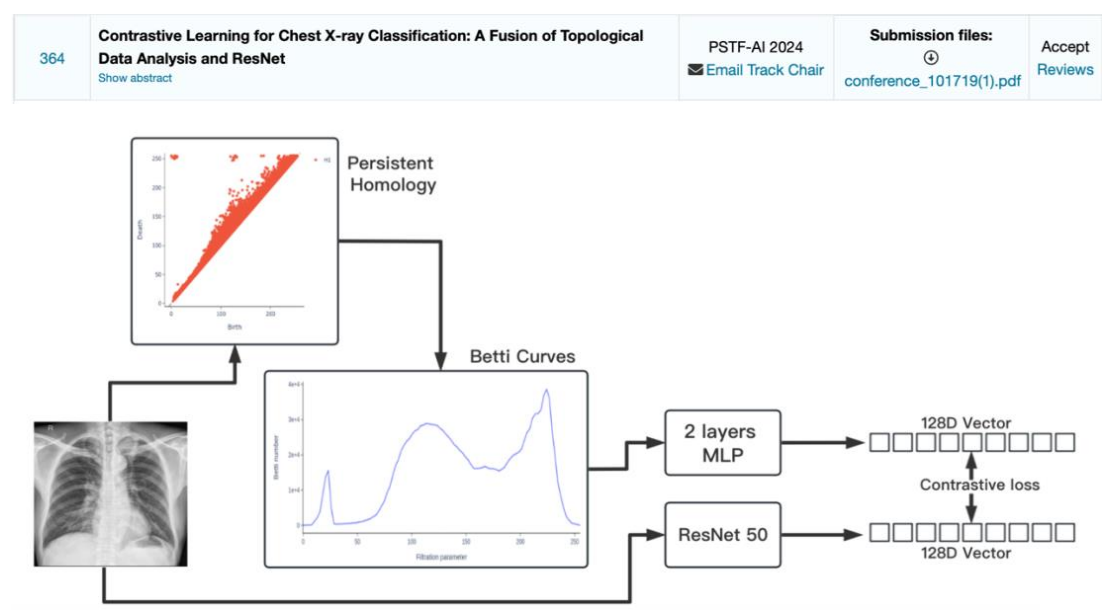
Based on this, I innovatively proposed a contrastive learning framework under TDA supervision, using TDA and ResNet50 as feature encoders, bringing them closer in a 128-dimensional space by computing cosine embedding loss to supervise ResNet’s learning. I tested my framework on three representative pulmonary disease datasets, and it demonstrated good performance. This paper is my representative work on the algorithm level.
Predicting Mortality Risk in Alzheimer’s Disease Using Machine Learning Based on Lifestyle and Physical Activity Y.X., Z.L.(Co-first author), X.S, T.G, X.T Frontiers in Psychiatry Computational Psychiatry(Third review, will be accepted soon)
Estimating Cardiovascular Mortality in Patients with Hypertension Using Machine Learning: The Role of Depression Classification Based on Lifestyle and Physical Activity X.L., Z.L(Co-first author), C.L., L.W., H.R., T.C. Current Problems in Cardiology(Reviewing) 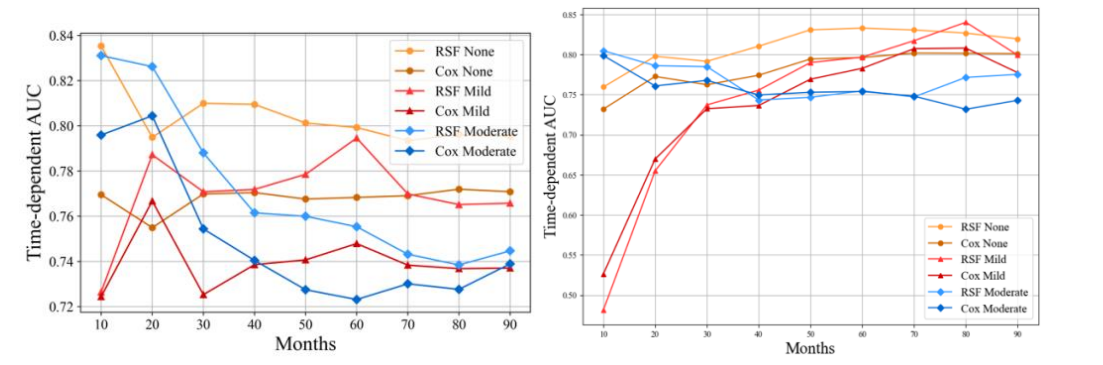
These two papers are based on the NHANES database. The first one predicts the mortality probability of Alzheimer’s disease, and the second predicts the cardiovascular mortality of hypertensive patients. The research in both papers is based on COX and Random Survival Forest (RSF) models.
The above is an excerpt illustration from the paper, used to show that the RSF model generally outperforms the COX model. Using RSF for clinical patient prediction and prognosis has shown good results.
Predicting Cognitive Decline in the Elderly Using Machine Learning: Insights from the Chinese Longitudinal Healthy Longevity Survey Y.Z., C.L., F.J., Z.L(Co-first author),H.R., Q.W., D.L., H.H., W.T., L.L., W.C. Journal of Alzheimer’s Disease(Reviewing)
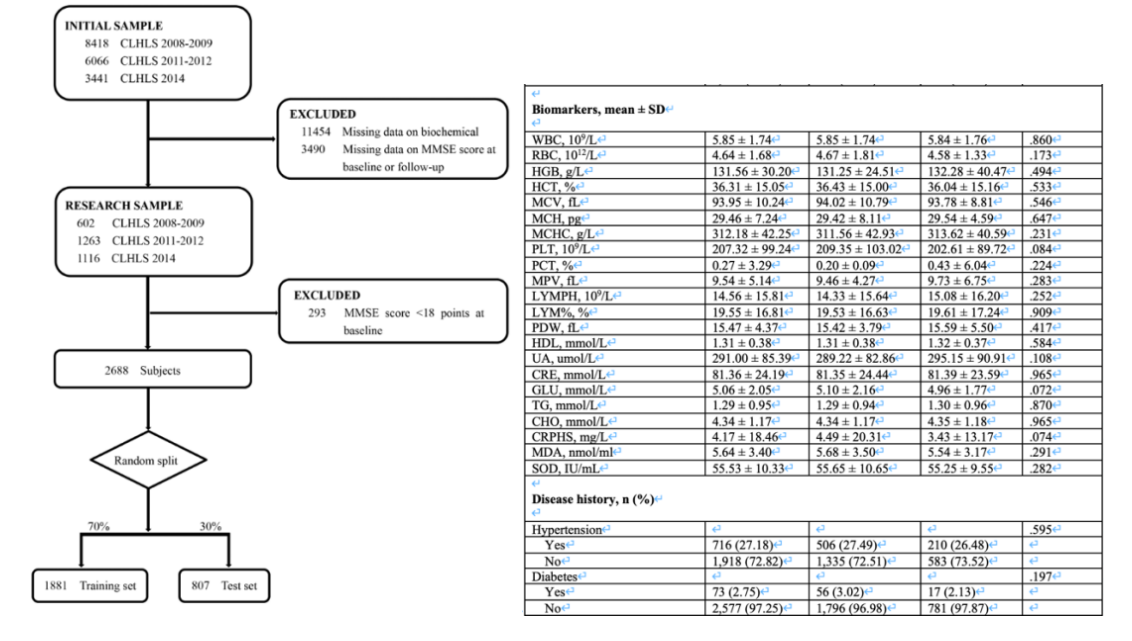
This paper is based on the Chinese Longitudinal Healthy Longevity Survey (CLHLS) database and aims to predict the degree of cognitive decline in elderly Chinese individuals under the influence of Alzheimer’s disease. We integrated mental status indicators of 2,688 patients, including 11 demographic and lifestyle factors, 22 biomarker variables, and 6 disease history indices, and achieved the best results using the Balanced Random Forest Classifier model.